The Future of Creative Work: Agentic Design Teams
An AI design team built as a structured production system, not a single assistant.
From assistant to production team
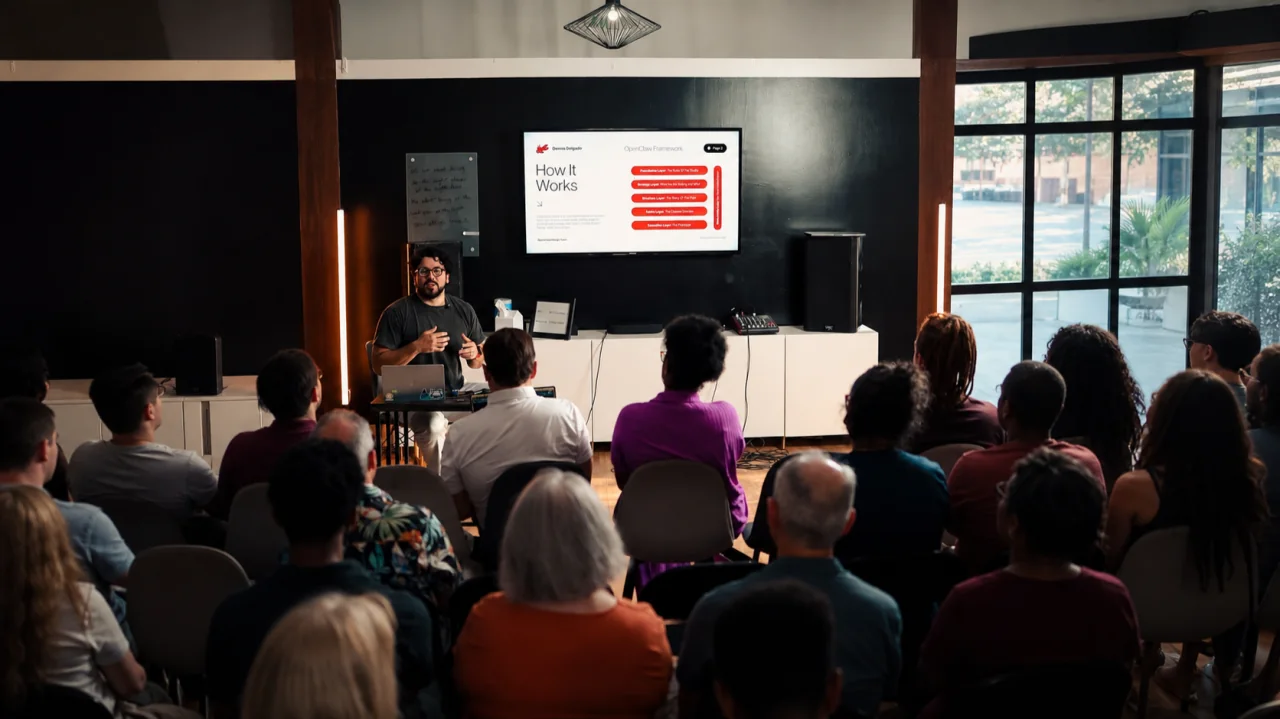
Recently, I got to demo my OpenClaw AI Design Team to a room of 50+ people at the Sacramento AI Collective meetup.
I originally built it for myself, partly to improve my own workflow and partly to see how useful this kind of team could actually be.
The idea came from my own design process. Good design rarely happens in one straight line. It moves through different modes of thinking: strategy, product clarity, UX structure, visual taste, technical feasibility, prototyping, and critique.
But most AI tools collapse all of that into one conversation.
I wanted to try something different:
What if an AI workflow behaved less like a single assistant and more like a structured creative production team?
The Big Idea
The OpenClaw Design Team is a role-based AI workflow.
Instead of asking one model to do everything, the system breaks work into specialist stages:
Strategy Analyst
PRD Specialist
Design Lead
UX Architect
Technical Architect
Prototype Engineer
QA Critique
Each role has a specific job, a different LLM depending on the role, clear inputs, defined outputs, and boundaries around what it should not touch.
That structure matters.
A real creative team does not usually jump from "I have an idea" straight into polished execution. There is framing, exploration, critique, alignment, and revision. The design quality comes from the handoffs as much as the individual talent.
AI gets more useful when you stop treating it like a genius and start treating it like a system.
The Prompt Is Not The Product
A lot of AI conversations focus on prompt quality.
Prompts matter, but in a workflow like this, the prompt is only the starting point.
The real product is the operating system around the prompt:
What context does the agent read first?
Where does the output live?
Which artifact becomes the source of truth?
When does a role stop?
What decisions need human approval?
What happens when two agents disagree?
That is where the quality comes from.
The strongest part of this experiment was moving away from loose chat memory and toward project-based artifacts. Each stage creates something concrete that the next stage can build on.
That makes the workflow easier to inspect, easier to improve, and less dependent on one perfect conversation.
AI Design Teams Need Governance
The more powerful the workflow gets, the more important boundaries become.
One of the key patterns I am exploring is separating the workspace into clear areas:
memory/ for shared rules, standards, model routing, and team agreements
skills/ for role-specific prompts
projects/ for active work artifacts
templates/ for reusable project structures
That sounds technical, but the principle is simple:
Shared rules should live in one place. Role behavior should stay focused. Project work should be easy to find.
Without that structure, AI workflows get messy fast. Prompts duplicate each other. Agents drift from their roles. Outputs land in random places. And suddenly the "automation" creates more coordination work than it saves.
The lesson: autonomy without governance is just noise at scale.
A custom design sprint monitoring dashboard I built to check detailed agent activity
The Human Role Becomes More Strategic
Building this shifted how I think about my own role as a designer.
The human is not removed from the loop.
The human becomes the person defining taste, constraints, approval gates, source material, and final judgment.
Instead of doing every step manually, I am designing the conditions for better work to happen: clearer briefs, sharper handoffs, stronger critique, and more repeatable standards.
For me, that is where AI gets exciting.
Not "replace the designer."
But give the designer a structured production team that can help move from idea to artifact faster, while keeping the person responsible for intent, quality, and taste.
The Best Workflows Mirror Real Teams
The most useful AI systems I have tested do not feel like chatbots.
They feel like operating models.
My OpenClaw Design Team works best when it mirrors how a strong product team already thinks:
Strategy clarifies the goal.
UX structures the experience.
Design direction shapes the feel.
Technical architecture checks feasibility.
Prototype engineering builds something reviewable.
Critique improves the output.
That sequence creates a healthier creative rhythm than asking one AI model to "make it good."
Good design is rarely one move. It is a chain of decisions.
Start Small, Then Earn More Autonomy
One of my biggest takeaways is that multi-agent workflows should start with low-risk use cases.
Before connecting anything to sensitive files, live products, client work, or important repositories, the system needs to prove itself in a sandbox.
Can it follow instructions?
Can it respect boundaries?
Can it create useful artifacts?
Can it explain what it changed?
Can it stop when it should stop?
That discipline matters. Especially as AI tools get more capable.
The goal is not to give agents every permission on day one. The goal is to build trust through repeatable, inspectable work.
What This Means For Design Teams
I think we are entering a new phase of AI-assisted design.
The first phase was individual acceleration: faster copy, faster images, faster mockups, faster code.
The next phase is workflow design.
How do we turn AI into a reliable part of the creative process?
How do we preserve taste, accountability, and strategic thinking?
How do we make systems that help teams move faster without flattening the craft?
That is what I am exploring with OpenClaw, Hermes, Claude Code, and Codex.
It is still early. I am still testing, refining, and learning where this kind of system is genuinely useful.
What would your team look like if your best process could become reusable infrastructure?
#AIDesign #OpenClaw #CreativeAutomation #ProductDesign #AIWorkflow #DesignSystems #Sacramento